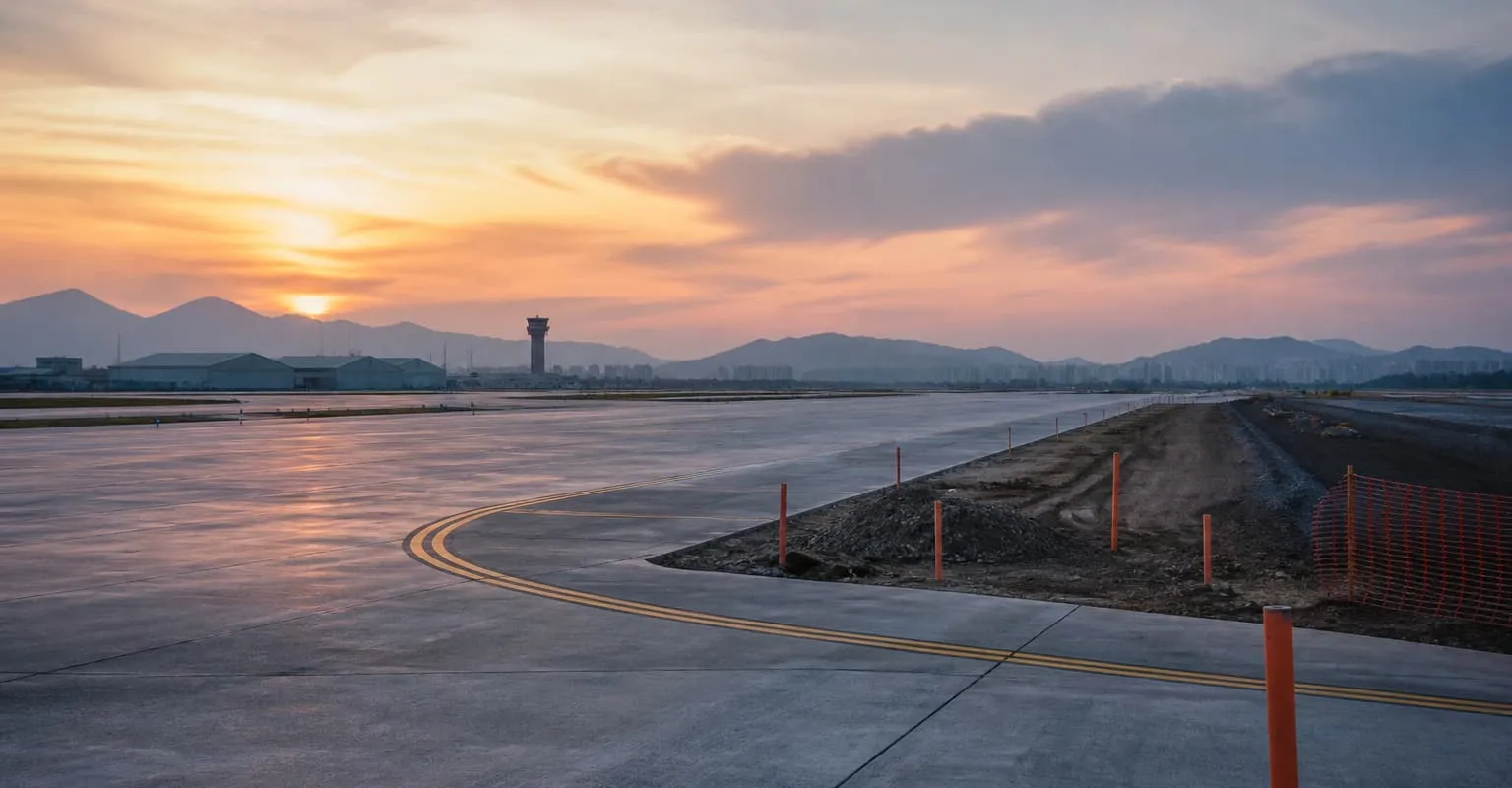
Korea business brief: Lee orders Gwangju Air Base cleared for a chip hub by 2028
President Lee told the Defense Ministry to move fighter operations out of Gwangju Air Base to make room for a semiconductor complex, part of a four-region chip and AI buildout benchmarked against TSMC's Kumamoto speed.
Source: The Korea Herald
What happened
President Lee Jae-myung has ordered the Defense Ministry to temporarily move Gwangju Air Base’s fighter operations to other military airfields by mid-2028, freeing the site for a new semiconductor industrial complex, according to The Korea Herald. Lee also directed the government to begin construction on adjacent land ahead of the full base handover, rather than waiting for the relocation to finish first. He explicitly benchmarked the project’s pace against TSMC’s Kumamoto, Japan fab, which the company built in about 22 months — a marker meant to signal Seoul wants speed, not just scale.
The breakdown
Gwangju becomes the anchor of a second “Honam” chip belt, part of a wider regional division of labor Lee laid out: Chungcheong for packaging, Yeongnam for physical AI, and non-capital regions generally steered toward hosting new AI data centers to ease land and grid pressure around Seoul. Ahead of the base’s full 8.26-square-kilometer footprint becoming available, the government is prepping a roughly 366,000-square-meter site at Mareuk-dong — a former ammunition depot — so an early fab can break ground sooner. Officials are also targeting a special law for “mega special zones” by year-end to fast-track permitting across these sites. The base currently stores U.S. wartime-reserve materiel, so Seoul is separately consulting Washington on relocating those American facilities as well; a companion Korea Herald report notes a U.S. official responded positively when asked. Samsung Electronics and SK hynix executives attended the announcement.
Why it matters outside Korea
For chip-supply-chain planners and foreign investors, this reframes Korea’s memory and foundry expansion as a real-estate and defense-basing project, not only a Yongin story. Benchmarking against TSMC’s Kumamoto timeline is a direct signal that Seoul intends to compete on build speed against Japan’s newer fab clusters, which matters to any buyer weighing where the next wave of Korean capacity lands and when. The U.S. wartime-asset relocation detail also puts this squarely on the radar of anyone tracking USFK basing and broader alliance logistics, not just chip economics.
What travelers and expats should watch
- Investors and suppliers eyeing Honam: treat mid-2028 as the base-transfer target, not a signal that land is immediately available — the Mareuk-dong site is the interim option while the main base footprint is still years out.
- Engineers or relocating workers considering Gwangju: expect job and construction activity to build gradually in the packaging and chip-adjacent supply chain; housing and infrastructure in a newly designated industrial zone typically lags the announcement by a wide margin.
- Security- and alliance-focused expats: the U.S. wartime-reserve relocation is still at the consultation stage — do not treat early positive signals as a finalized basing decision.
- Anyone doing business near the announced special zones: watch for the year-end special law on “mega special zones,” since that is where concrete permitting and land-use rules will actually change, not the presidential order itself.
Context
Read this as an industrial-policy speed bet that uses defense land as public collateral to compress a build timeline, not as confirmation of any specific company’s investment plan. Samsung and SK hynix attending the event signals political coordination and buy-in, not a contracted commitment to build at Gwangju on this schedule. This is a policy and land-use watch, not investment advice.
Source
Primary: The Korea Herald: Lee orders Gwangju Air Base cleared for chip hub by 2028. Secondary, same desk: a companion Korea Herald report (koreaherald.com/article/10836538) on the U.S. consultation over relocating American wartime-reserve facilities. Facts paraphrased for briefing; read the originals for full detail.