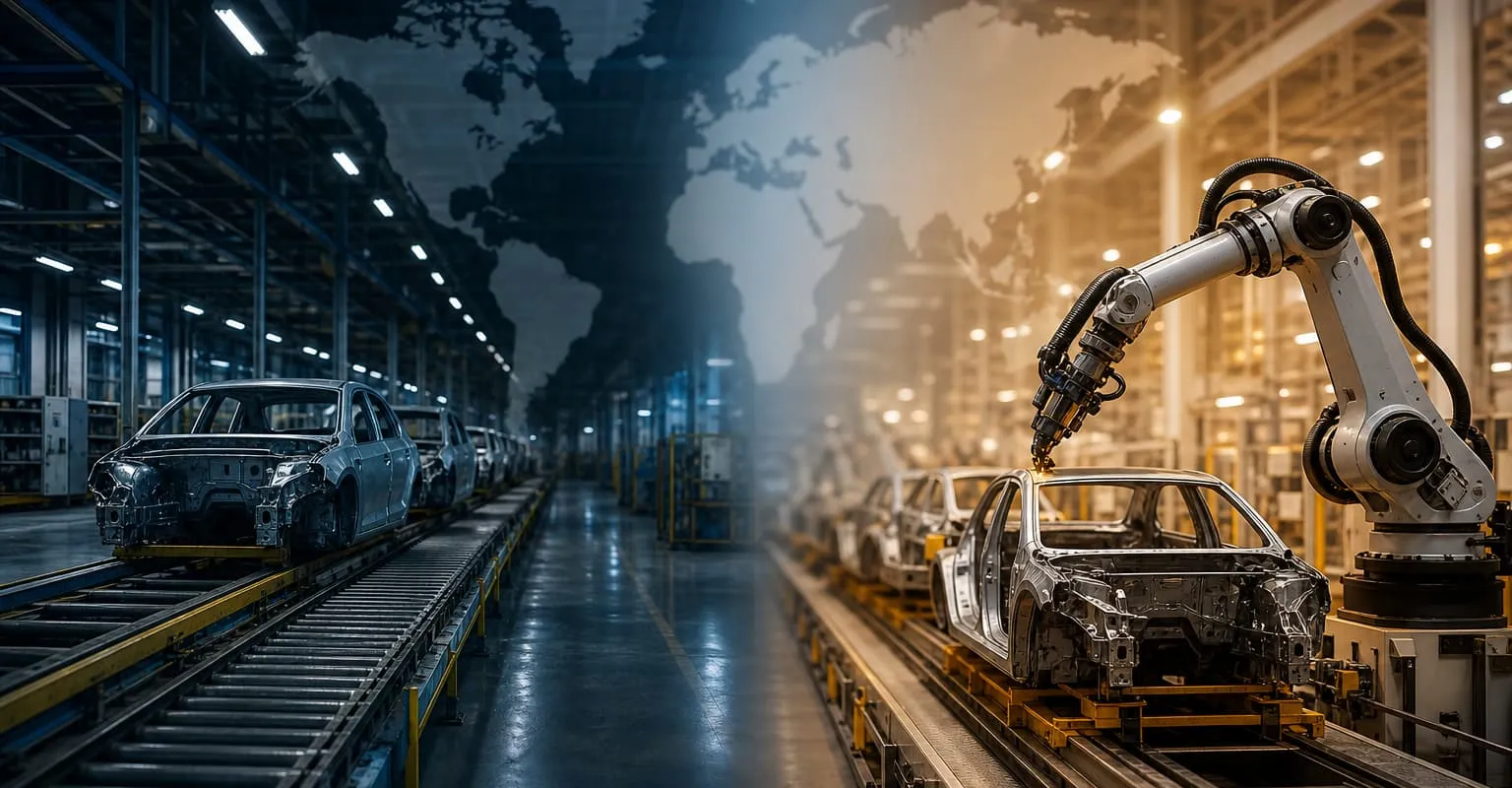
Korea business brief: Hyundai strike deal closes, but U.S. robots and capacity shift the production map
Sisa Journal reports Hyundai's union tentatively agreed on Aug. 25 after 60 strike hours and 55,000-plus lost units, while the group plans 500,000 more North American capacity and Atlas humanoid robots from 2028.
Source: Sisa Journal · 경제
What happened
Hyundai Motor’s union and management reached a tentative wage deal on Aug. 25 at Ulsan, 111 days after talks opened on May 6. Sisa Journal reports the package includes a 100,000 won monthly base-pay increase, a performance bonus of 400% plus 12.7 million won, 15 shares, and 500,000 won in welfare points, plus hiring 500 technical workers by 2028. A union vote on Aug. 31 will decide ratification.
The breakthrough follows costly stoppages. Partial strikes ran from July; on Aug. 21 Ulsan, Asan, and Jeonju held an eight-hour full strike — the first plant-wide action in a decade. Strike time this year reached 60 hours, with lost production above 55,000 vehicles and revenue disruption estimated above 2 trillion won.
The breakdown
Korea still anchors volume. First-half 2026 domestic output was 897,929 vehicles — far above India (367,400), the U.S. (201,000), or Czech (135,400). Annual domestic capacity is about 1.8 million units before a new 200,000-unit Ulsan EV plant. Hyundai plans 200,000 more domestic capacity by 2030 and Ulsan modernization from 2027.
The overseas plan is larger and more automated. At 2026 CEO Investor Day, Hyundai pledged 1.27 million more global units by 2030; North America accounts for 500,000 — 2.5 times Korea’s 200,000. CEO Jose Munoz said Georgia’s Metaplant America could grow from 500,000 to 700,000–800,000 units by 2028. U.S.-built share of American sales should rise from 40% in 2024 to more than 80% by 2029, with local parts sourcing moving from about 60% to 80% by 2030.
From 2028, Boston Dynamics’ Atlas humanoid robots are slated for Georgia, starting with parts sorting and expanding toward assembly, alongside a U.S. robot factory targeting 30,000 units a year. Samsung Securities puts labor at 7–8% of Hyundai–Kia manufacturing cost and sees roughly one percentage point of annual savings possible after 2028. In Q2 2026, the U.S. became Hyundai’s largest market at 26.7% of 992,000 global sales.
Why it matters outside Korea
Hyundai is not abandoning Korean plants — but strike-prone domestic output and tariff-shielded U.S. expansion are diverging. For anyone tracking Korean industrial policy or chaebol labor risk, a ratified deal may stop immediate stoppages without erasing 55,000-plus lost units or the strategic tilt toward North American capacity, local parts, and automation.
What travelers and expats should watch
- Delivery timelines: If you ordered a Hyundai or Kia tied to Korean export or local delivery, ask whether your build faced the Aug. 21 full strike or earlier partial stoppages — backlog risk can linger after a Aug. 31 vote.
- U.S.-built vs Korea-built models: With 80%+ U.S. local production targeted by 2029, American buyers should compare origin labels and tariff pass-through; Korea-based buyers importing U.S.-spec cars may see different trim and parts sourcing as Georgia scales.
- Robot rollout from 2028: Atlas deployment at Georgia is a concrete cost-and-uptime milestone when evaluating long-dated supplier contracts tied to automated U.S. sites.
Context
Read this as a labor truce inside a production-map rewrite, not proof Hyundai is exiting Korean factories. Sisa Journal’s framing — strikes at home, robots in America — captures the tension: domestic investment continues, but lost output and trade localization make overseas efficiency the benchmark. Daerim University professor Kim Pil-soo warns repeated strikes amid high domestic labor costs could accelerate overseas expansion and hollow local industry if automation also faces union resistance. The question is not whether Ulsan still builds cars; it is whether Ulsan keeps winning the next marginal unit when Georgia adds capacity, parts, and robots in parallel.
Source
Sisa Journal · 경제: “국내선 파업, 미국선 로봇”…현대차 ‘생산 지도’ 바뀌나 — Korean original; paraphrased for briefing. Soft briefing only — not personalized investment, tax, or labor advice.