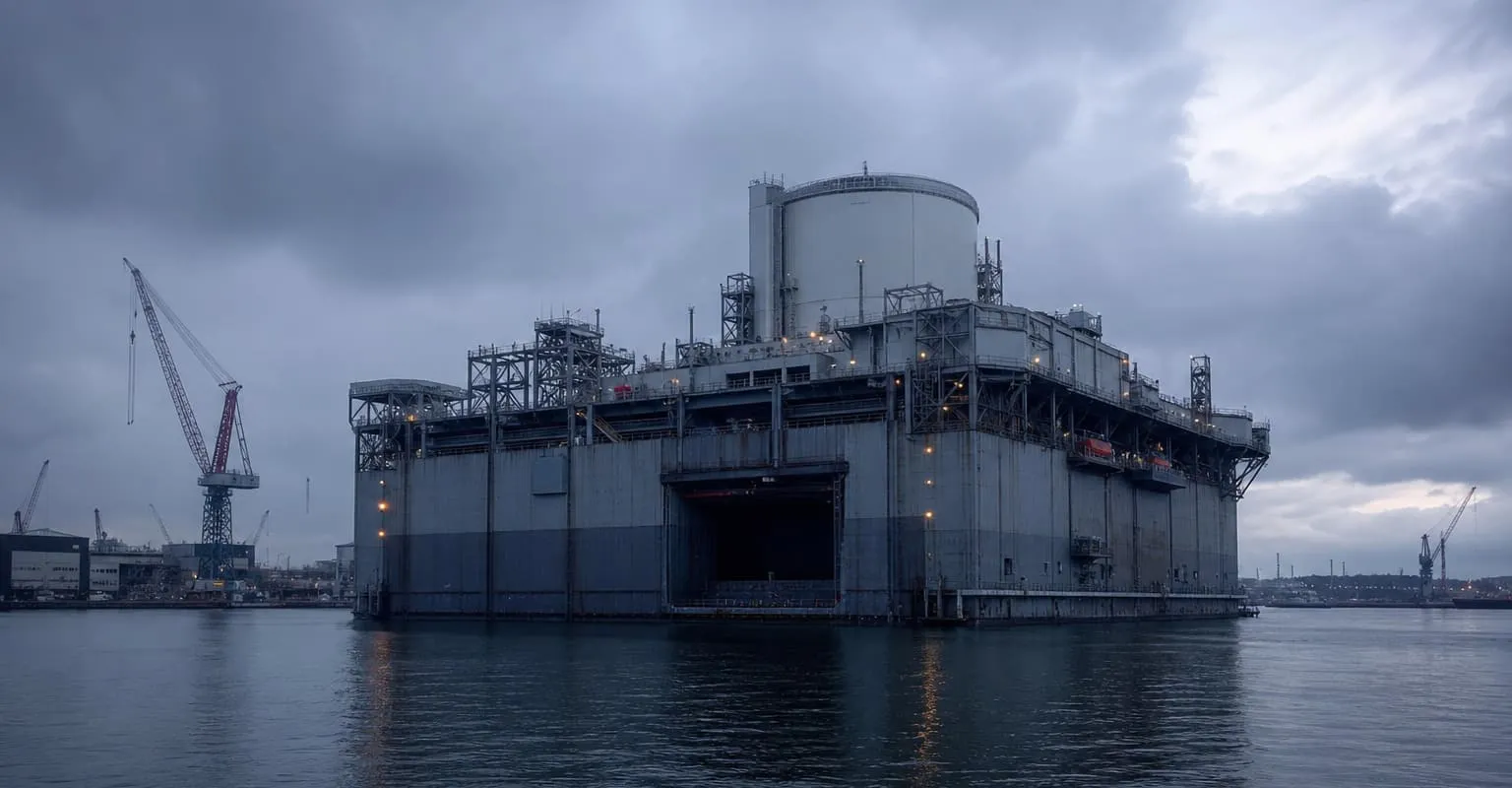
Korea business brief: Samsung Heavy teams with Sargent & Lundy on floating SMRs
An MOU for a standardized floating small modular reactor platform — shipyard EPC meets U.S. nuclear engineering.
Source: Yonhap News Agency
What happened
According to Yonhap, Samsung Heavy Industries said Wednesday it signed a memorandum of understanding with U.S. engineering firm Sargent & Lundy to jointly develop floating small modular reactors (FSMRs).
The company press line, carried by Yonhap, is specific about the product thesis: a standardized FSMR platform that can host a range of reactor technologies, not a single locked-in reactor type — framed as “unrivaled versatility” for global customers choosing among options. The signing photo was taken in Washington on July 21 (U.S. time), with Samsung Heavy’s Future Business Division head Kim Kyung-hee and Sargent & Lundy’s chief nuclear officer Shiven Sulkar.
The breakdown
Hold the MOU to what is actually on the page:
- Samsung Heavy role: engineering, procurement, and construction (EPC) for offshore plants.
- Sargent & Lundy role: nuclear design and engineering expertise.
- FSMR definition (company/Yonhap): a floating nuclear power platform that generates electricity using an SMR installed on a floating structure.
- Market intent stated: strengthen Samsung Heavy’s position in the U.S. market by pairing Korean offshore EPC with American nuclear process know-how.
- What is not in the wire: dollar size, reactor vendor shortlist, licensing schedule, or a prototype hull date. An MOU is collaboration intent, not a licensed plant.
Why it matters outside Korea
Korea’s export story is often told as chips, cars, and K-content. Floating SMRs sit at a quieter intersection: shipbuilding/offshore plus nuclear supply-chain ambition. For overseas energy and infra readers, the signal is that a major Korean yard wants to sell platform flexibility — one floating chassis, multiple reactor options — into markets where reactor choice is political and regulatory, not only technical.
That is why Washington matters in the photo caption. The U.S. is both a nuclear-engineering partner culture and a target-market narrative. Readers who follow SMR debates in the U.S., Middle East, or island grids should file this under “Korean yards entering the floating-nuclear conversation,” not under “reactor already ordered.”
What travelers and expats should watch
- Do not confuse MOU with groundbreaking. There is no public build timeline in the Yonhap piece.
- Watch the next concrete milestone: named reactor technology partners, licensing path language, or an actual platform/hull program announcement.
- Industry literacy: FSMR = SMR + floating structure; the shipyard is selling the ocean platform stack as much as the atom.
- U.S. angle: Sargent & Lundy is the credibility bridge for American nuclear engineering process culture.
Context
Korelay’s take: read the MOU as a positioning move in the global SMR race. Korea’s edge pitch here is offshore EPC plus multi-reactor platform design — not a claim that floating nukes are ready for your coastal weekend. Track the next hard deliverable; until then, it is industrial diplomacy with a shipyard logo.
Korelay take
Korelay’s take: read the MOU as a positioning move in the global SMR race. Korea’s edge pitch here is offshore EPC plus multi-reactor platform design — not a claim that floating nukes are ready for your coastal weekend. Track the next hard deliverable; until then, it is industrial diplomacy with a shipyard logo.
Editor note: Desk reporting supplies the timeline; Korelay adds the overseas behavior layer (what to change, what not to assume, what to re-check). If you only need the wire facts, open the primary link in Source.
Source
Yonhap: Samsung Heavy signs MOU with U.S. firm to advance FSMR development — paraphrased for briefing; read the original for full detail.