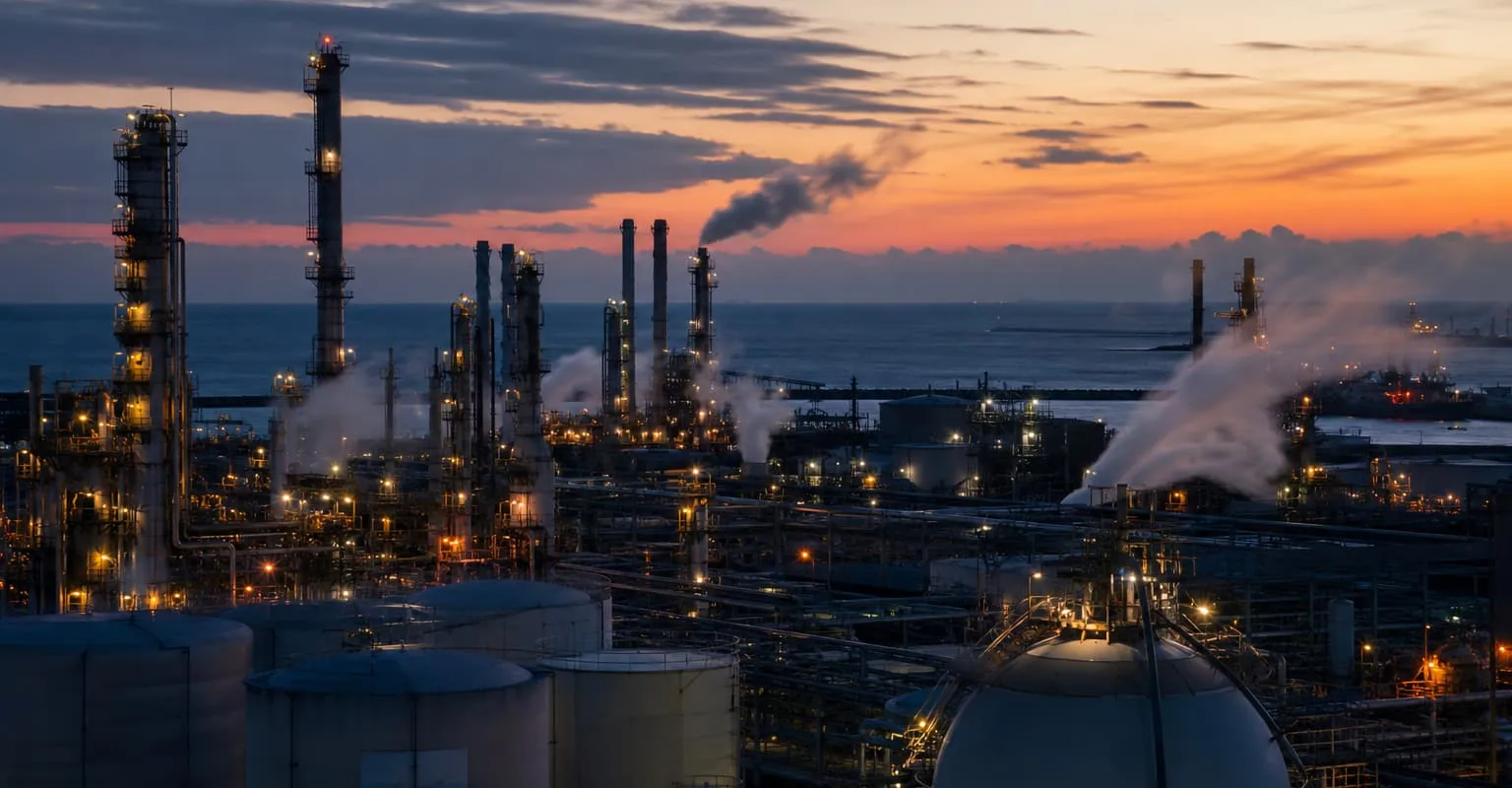
Korea business brief: government OKs Yeosu petrochemical restructuring
Lotte NCC spin-merge, DL and Hanwha integration, ₩800bn private injection and ₩700bn+ state support — second complex after Daesan.
Source: Yonhap News Agency
What happened
According to Yonhap, citing the industry ministry, South Korea approved a restructuring plan from petrochemical companies at the Yeosu industrial complex — about 320 km south of Seoul — amid a prolonged petrochemical downturn driven by global oversupply.
It is the second restructuring project approved under the government’s push for “voluntary” self-restructuring, after a Daesan plan in February.
The breakdown
Ministry details carried by Yonhap:
- Lotte Chemical will spin off its naphtha cracking center (NCC) operations at Yeosu and merge them with Yeochun NCC.
- The merged entity will integrate core businesses of DL Chemical and Hanwha Solutions at the complex — including DL’s polyethylene (PE) and Hanwha’s PE and petroleum resin lines — to streamline NCC facilities and commodity petrochemical production.
- DL Chemical and Hanwha Solutions plan to inject a combined 800 billion won (about US$576 million) to repay debt and fund restructuring.
- After approval, companies are set for more than 700 billion won in government support — financial assistance, tax incentives, and regulatory relief.
- Daesan precedent (February): Lotte Chemical and HD Hyundai Chemical plan aimed at voluntarily cutting combined NCC capacity by 1.1 million tons.
Why it matters outside Korea
Korea’s petrochemical map is not a tourist story, but it is a supply-chain and industrial-policy story. Yeosu is one of the country’s core chemical hubs; approving a multi-firm consolidation signals Seoul is willing to underwrite capacity discipline rather than let every cracker bleed alone through the oversupply cycle.
For overseas readers following plastics, batteries, and materials inputs, this is the midstream reset behind later “high-value chemicals” pivots.
What travelers and expats should watch
- If you work in Yeosu / Yeocheon industry towns: expect corporate boundary changes more than overnight shutdown tourism effects.
- Policy keywords: voluntary restructuring, NCC streamlining, government support package.
- Sequence: Daesan first, Yeosu second — Ulsan talk has been part of the broader reform conversation in earlier coverage.
- Not an energy-crisis headline: this is oversupply and competitiveness, not a sudden fuel shortage.
Context
Korelay’s take: the overseas-useful frame is industrial triage with a price tag — private ₩800bn plus ₩700bn+ state support around an NCC spin-merge. Read it as Korea trying to shrink and specialize commodity petrochem capacity before the glut does it less neatly.
For supply-chain readers abroad, Yeosu is a midstream reset signal: fewer overlapping commodity lines, more state-backed consolidation, and a template that already started at Daesan. Watch whether utilization and product mix actually shift after the legal merge work finishes.
Korelay take
Korelay’s take: the overseas-useful frame is industrial triage with a price tag — private ₩800bn plus ₩700bn+ state support around an NCC spin-merge. Read it as Korea trying to shrink and specialize commodity petrochem capacity before the glut does it less neatly.
For supply-chain readers abroad, Yeosu is a midstream reset signal: fewer overlapping commodity lines, more state-backed consolidation, and a template that already started at Daesan. Watch whether utilization and product mix actually shift after the legal merge work finishes.
Editor note: Desk reporting supplies the timeline; Korelay adds the overseas behavior layer (what to change, what not to assume, what to re-check). If you only need the wire facts, open the primary link in Source.
Source
Yonhap: Gov’t OKs restructuring plan for Yeosu petrochemical complex — paraphrased for briefing; read the original for full detail.