Korea culture brief: Three Little Pigs musical with no wolf on stage
Dong-A Ilbo reviews Lee Ha-neul's musical 'So the Wind Blew, and I Ate My Two Brothers' at Sejong Center — a dark Three Little Pigs retelling that runs August 15–17.
Source: Dong-A Ilbo · 문화연예
What happened
According to Dong-A Ilbo, a new music-theater piece opened on the afternoon of August 15 at the S Theater inside Seoul’s Sejong Center for the Performing Arts in Jongno. Titled So the Wind Blew, and I Ate My Two Brothers (Korean: Geureoke barami bul-eossgo, naneun du hyeongeul meog-eossda), the show runs August 15–17 — three days total.
Composer Lee Ha-neul serves as both music director and director. The work starts from a deliberately crooked reading of The Three Little Pigs: instead of the youngest pig defeating the wolf and living happily ever after, the youngest eats the wolf that devoured the first two brothers and absorbs them. That reversal supplies the title.
The breakdown
Dong-A reports that the piece cares less about classic good-versus-evil (권선징악) than about how the pigs feel around the wolf as a symbol of fear. Before the house lights even dim, staging cues associated with “cruel fairy tales” (잔혹동화) are already visible. Three pig characters circulate through the audience waving — but Dong-A describes them as closer to unsettling cosmic creatures than cute storybook animals.
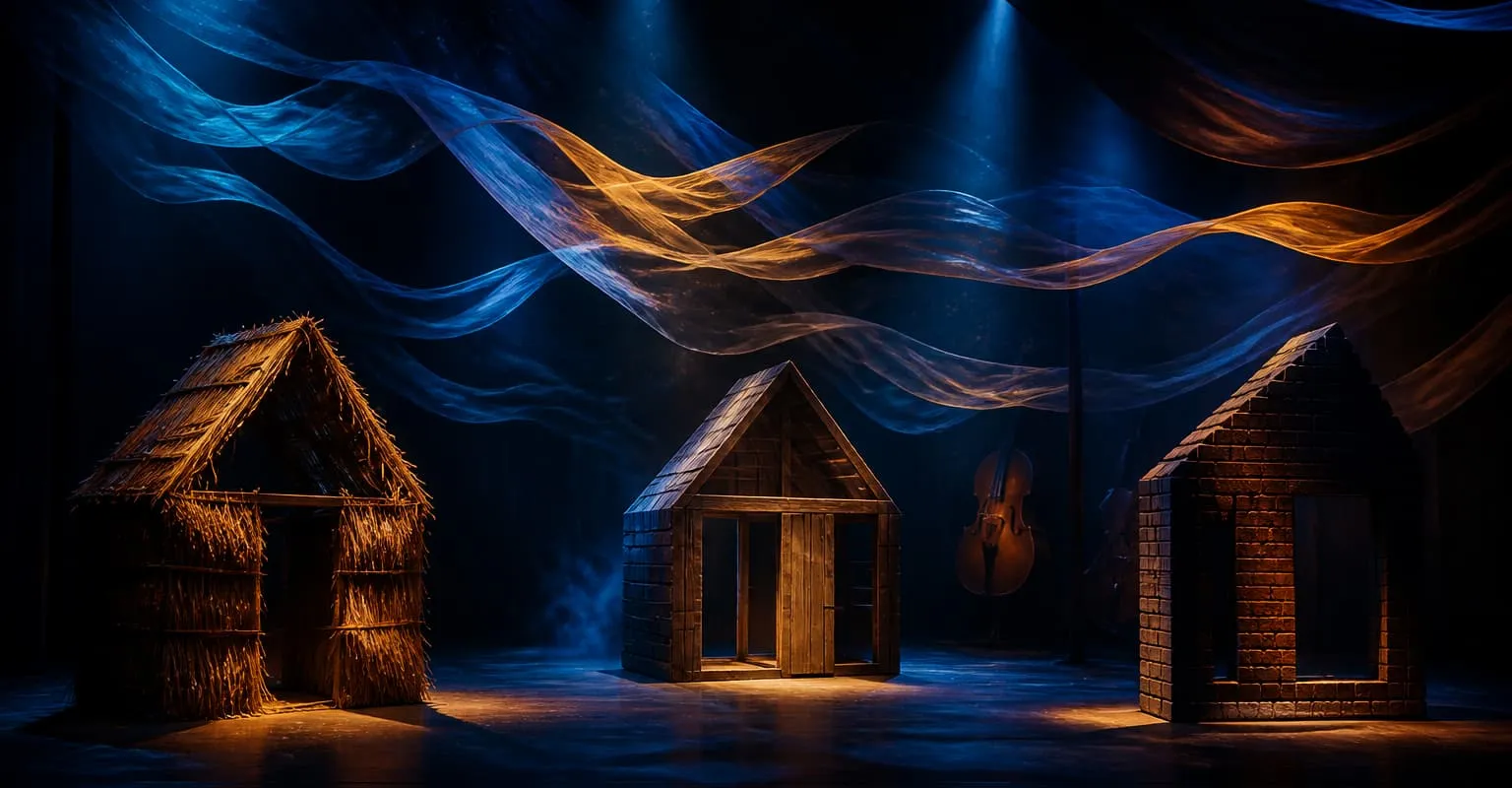
Roof-shaped structures evoke the three houses, yet original plot points arrive as fragmented metaphors rather than straight narration. The score mixes violin, cello, other classical strings, percussion, vocals, electronic music, and synthesizers to build intentional discomfort.
The article’s sharpest twist: the wolf, the tale’s central figure, never appears on stage as a visible character. It remains a phantom (허상). In a pre-show written interview cited by Dong-A, Lee said invisible forces — fear, rumor, belief, prejudice, religion, ideology — can sometimes outweigh what is physically verifiable, and that she wanted to frame that structure through the symbol of the wolf.
Strong sound and imagery push the audience forward, but the piece also leaves the question of how much is deliberate incompleteness. Dong-A’s verdict: it favors strangeness and open questions over neat answers.
Why it matters outside Korea
Seoul’s nonprofit stages and composer-led theater labs are a practical window into how Korea reworks global fairy-tale stock for adult audiences. Lee Ha-neul has drawn recent attention as a composer, and this run shows how a familiar English-language classroom story can be stripped of its moral comfort in favor of political-psychological metaphor.
For anyone tracking K-culture beyond K-pop and K-drama, small-format music theater at landmark venues like Sejong is part of the same export ecosystem: festival programmers, drama-school graduates, and expat audiences all scout these rooms for what might travel next.
What travelers and expats should watch
- Venue and dates: Sejong Center S Theater, Jongno, August 15–17. Dong-A’s review covers the opening afternoon; if you are visiting Seoul that weekend, check Sejong’s box office or Korean listing sites for remaining seats and whether English supertitles are offered — the article does not mention translation.
- Expectation management: Dong-A warns that anyone arriving for a cozy bedtime story will be “betrayed” repeatedly. This is immersive, loud, and metaphor-heavy — not a family matinee version of Three Little Pigs.
- Accessibility: Jongno is central but the piece’s pre-show audience interaction (characters moving through the seating area) may affect where you want to sit if you prefer minimal contact.
- Language: Primary materials and press quotes are Korean; bring a friend or read plot summaries beforehand if your Korean is limited.
Context
Read this as a short-run avant-garde fairy-tale deconstruction at a major Seoul hall, not as proof that Korea’s mainstage theater has abandoned linear storytelling. Dong-A documents one three-day engagement built around symbol, sound design, and an absent wolf — useful for culture tourists mapping how familiar Western tales get reframed locally. It is not a box-office blockbuster headline; it is a critic’s snapshot of an experimental music-theater run.
Source
Dong-A Ilbo · 문화연예: 늑대 없는 ‘아기돼지 삼형제’… 친숙한 동화 확 비튼 음악극 — Korean original; paraphrased for briefing; dates and quotes from Dong-A; read the original for full detail.