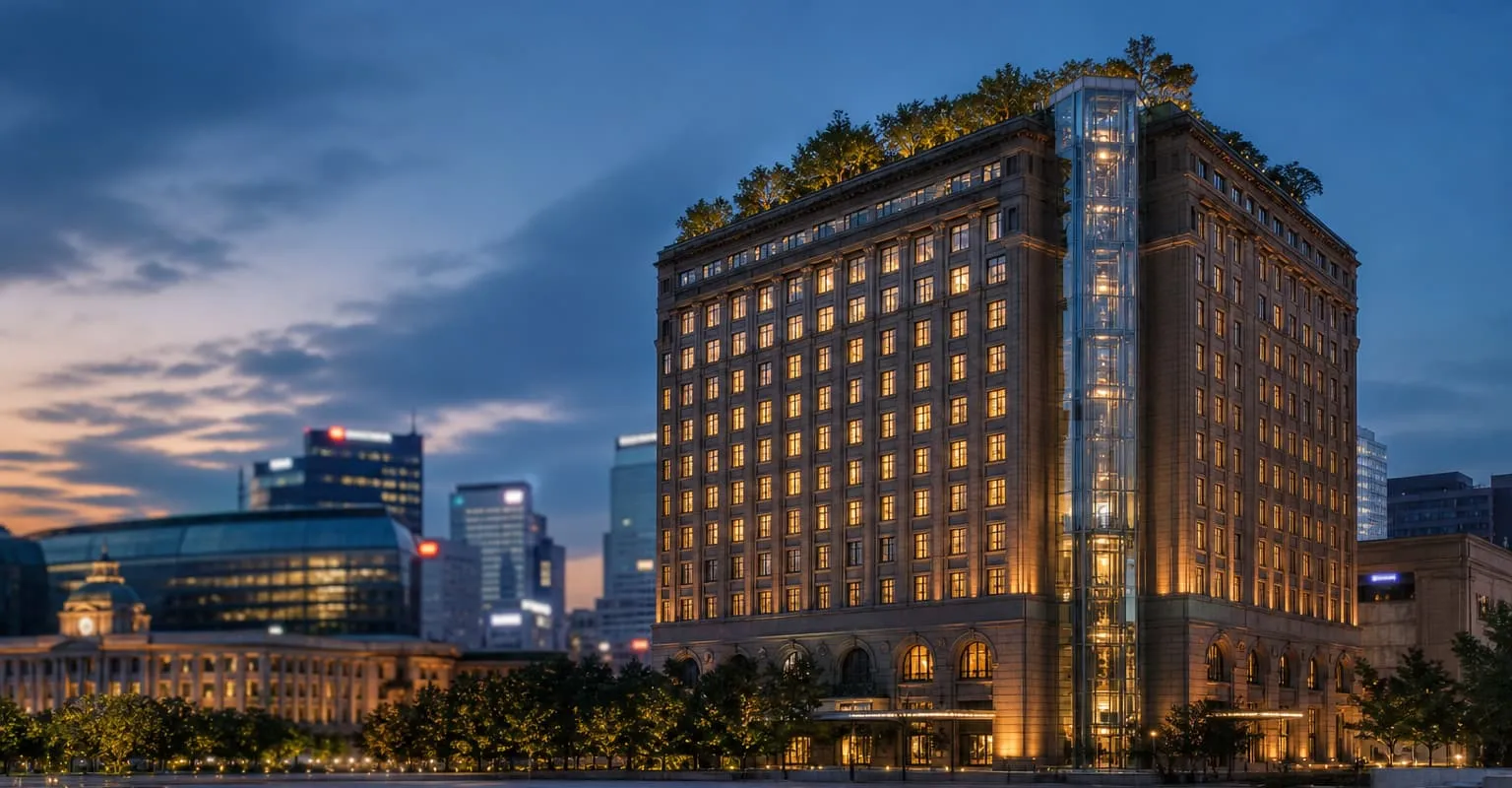
Korea food-travel brief: The Plaza Seoul targets '7-star' rebuild from early 2027
Dong-A Ilbo reports Hanwha Hotels & Resorts will spend about three years remaking The Plaza at Seoul Plaza into suites, Michelin-tier dining, and a public rooftop garden — what business travelers and luxury tourists should plan for.
Source: Dong-A Ilbo · 여행
What happened
According to Dong-A Ilbo (Aug. 19), The Plaza — the landmark hotel in front of Seoul City Hall and Seoul Plaza — will undergo a full renovation aimed at repositioning it as a “7-star high-end hotel.” Owner Hanwha Hotels & Resorts tied the announcement to the property’s 50th anniversary, citing stronger competitiveness and better guest convenience.
Work starts early next year and runs for about three years, the desk reported — the first major overhaul since a 2010 renovation, roughly 16 years later.
The breakdown
Dong-A frames the project as heritage outside, luxury inside, and a public amenity on top:
- Exterior: The founding-era façade stays; Hanwha is pitching continuity with The Plaza’s original downtown silhouette, not a glass-box reboot.
- Rooftop access: A dedicated exterior elevator would carry all citizens, not only guests, to a rooftop garden — unusual for a flagship city-center tower above Seoul Plaza foot traffic.
- Rooms: Inventory shifts from deluxe-heavy toward top-tier suites, each with a work space — a bet on long-stay executives over standard tourist doubles.
- Food and beverage: Hanwha plans Michelin-star-level fine dining and other world-class F&B operators.
- Global flag: The company is pursuing membership in The Leading Hotels of the World (LHW), the luxury independent alliance whose roster includes Ritz Paris.
The article does not publish a won budget, room counts, closure dates, or interim branding.
Why it matters outside Korea
The Plaza anchors one of Seoul’s most photographed blocks — steps from City Hall Station, rallies, ice rinks, and festival staging on Seoul Plaza. A three-year rebuild there ripples beyond Korea’s luxury segment.
Corporate travelers should read the suite-and-work-zone pivot as a chase for extended-stay executives and high-yield meetings business. An LHW push would put Seoul’s civic front lawn back on the same marketing maps as Paris and other legacy capitals — relevant for alliance-filtered loyalty travelers. The citizen-accessible rooftop garden is also a city-interface experiment: a marquee tower offering public vertical access, not only guest-only penthouses.
What travelers and expats should watch
- Booking horizon: If your 2027–2029 Seoul plan assumes The Plaza as a base, watch for partial closures and brand churn once work starts early next year — the desk gives no phased handover dates.
- Seoul Plaza logistics: Construction near Taepyeong-ro can ripple into City Hall event detours and festival crowds; budget extra walking time even if you stay elsewhere.
- Rate drift: A suite pivot plus Michelin-tier F&B usually means higher rack rates and fewer entry-level rooms post-reopening — compare L7, Lotte, and Four Seasons before locking corporate blocks.
- LHW timing: Alliance admission is planned, not confirmed. Do not book expecting LHW recognition until Hanwha announces acceptance.
Context
Read this as a flagship owner reinvesting in Seoul’s civic front door ahead of a 50-year milestone, not as “Seoul suddenly has official 7-star hotels.” “7-star” is marketing language in the Korean press — there is no global seven-star rating body — and the useful signal is suites + Michelin recruitment + LHW ambition + a public rooftop, not star-count hype.
Korelay’s frame: treat early 2027 as the planning trigger for downtown hotel disruption; do not expect new dining or garden access until the ~3-year window closes unless Hanwha publishes interim openings.
Source
Dong-A Ilbo: “서울시청 앞 ‘더 플라자’ 호텔, 7성급으로 내년부터 리모델링” — paraphrased for briefing; renovation timeline, room strategy, F&B plans, LHW pursuit, and rooftop elevator attributed to the desk; Korean original.